
Kent County 24-Hour Release Gap
As of July 24, 2026, the Kent County Sheriff’s Office does not publish an official rolling list of people released during the prior 24 hours. The county’s Inmate Lookup page describes the linked Jail Viewer as a source for people currently held. Its date boxes are booking-date filters. They do not turn the Viewer into a release-date feed, and no release filter or displayed release-date column was found during the official-source sweep.
This distinction matters in Kent County because jail turnover is fast. The 2025 KCCF annual report says 47 percent of stays ended within 23 hours. A current roster is therefore a poor archive of same-day departures. Someone missing from the Viewer may have bonded out, completed a term, been released at court, transferred to MDOC, moved to another agency, or stopped appearing because of a data issue. The absence alone does not select among those outcomes.
Important: A Viewer no-hit does not prove community release. Confirm the event with KCCF, MI-VINE, the court, or a KCSO release record.
The official Kent Jail Viewer is the right first snapshot. Its captured screen shows why it must be treated as a custody check rather than a same-day release list.
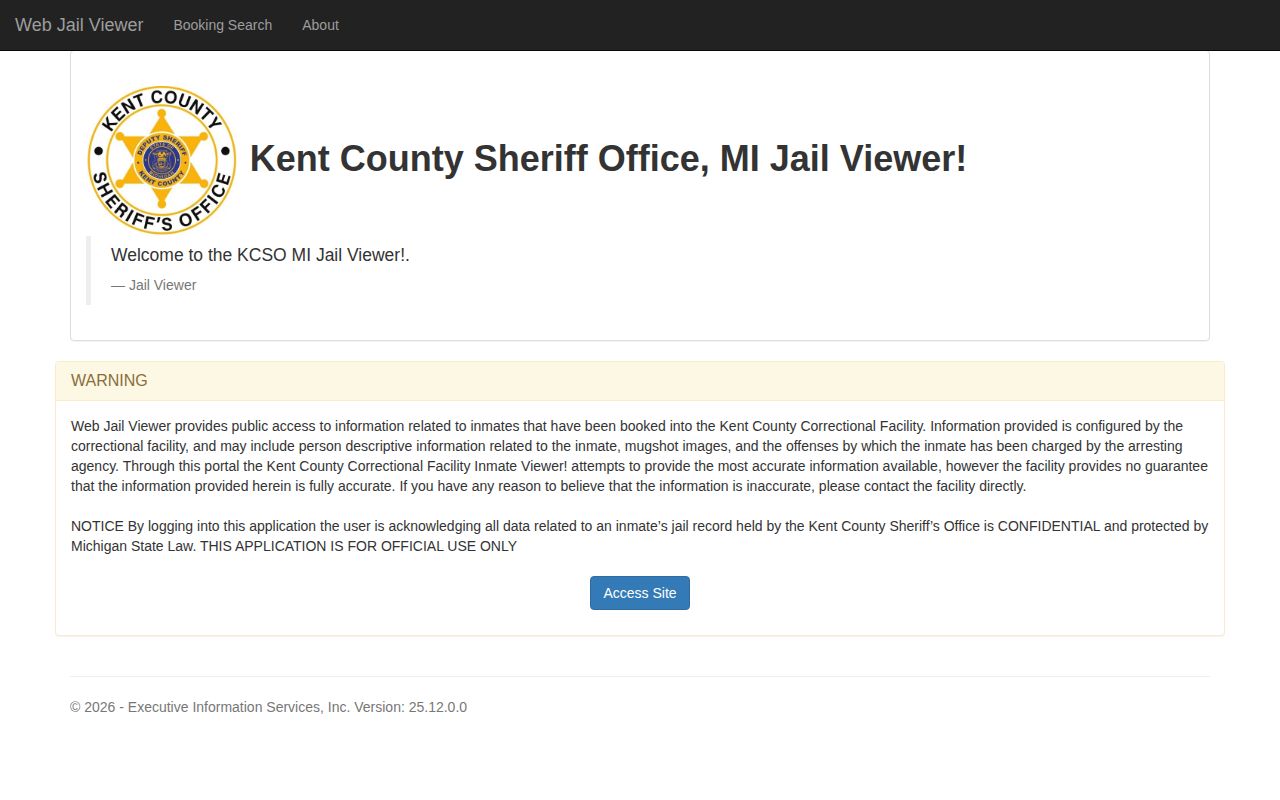
The Viewer can anchor the booking identity and current banner, but another source must establish a release time, release type, or transfer destination.
Check Kent County 24-Hour Releases
Define the period before searching. “Today” begins at midnight, while “the last 24 hours” rolls back from the current time. Give KCCF a precise start and end, such as 3 p.m. yesterday through 3 p.m. today. That prevents a release near midnight from being missed or counted in the wrong window.
- Search the Jail Viewer with the complete last name. Add the full first name and a narrow booking-date range, then save the booking number and case number.
- Read the custody banner. If it says the person is in custody, do not replace that status with a guess based on an end-of-sentence or bond field.
- Call KCCF inmate information at 616-632-6300, option 1. Ask whether that booking ended in community release or transfer during the defined window.
- Check Michigan through VINELink, or call MI-VINE at 800-770-7657. Quote the exact reported status and event date.
- Read the matching district or 17th Circuit Court case for the bond, dismissal, sentence, or commitment order. The order explains authority, not the exact jail-door time.
- If the exact event matters, request the KCSO release or movement screen with the booking number, date range, release type, time, and destination.
A person who only served at KCCF may never appear in OTIS, Michigan’s state correctional database. Use OTIS only when a judgment sent the person to MDOC or the person is under MDOC parole or probation. For a wider recent period, the Kent County 72-Hour Release List explains how to reconcile three days of events.
MI-VINE can strengthen a recent check when it reports a specific event from KCCF, but its label must be quoted as shown. “Released” or “out of custody” means the reporting custodian recorded a departure. It does not rule out a transfer, another warrant, or supervision. If the result and the Viewer disagree, call KCCF instead of choosing whichever screen looks newer.
Note: The phone response is useful for quick confirmation, but the release or movement record is stronger evidence of the recorded physical event.
Kent County Release Fields
Because Kent County has no 24-hour feed, there is no official feed-field set to promise. The current Viewer and the underlying KCSO release or movement record serve different roles. A Viewer result can supply identifiers needed for the request, while the agency record can document the departure event. Ask for the fields below and accept redaction of material that is exempt.
| Field | What it establishes |
|---|---|
| Name and booking number | Ties the result to one Kent County booking episode rather than a similar name. |
| Booking date and time | Marks entry into KCCF custody, not release. |
| Custody banner | Shows the Viewer’s present status snapshot when checked. |
| Release date and time | Places the recorded departure inside or outside the chosen 24-hour clock. |
| Release type | May distinguish bond, time served, dismissal, release at court, or another lawful outcome. |
| Destination or agency | Shows whether the person went to the community, MDOC, another county, or another custodian when recorded. |
| Court and case number | Connects custody movement with the legal order and pending case. |
Viewer details may also contain a photo, descriptions, charges, arresting agencies, bond or fine data, disposition, and an end-of-sentence field when supplied. The county says this information can change quickly and may be incomplete. It publishes neither a guaranteed refresh interval nor a promise for how long a released booking stays visible.
Kent County Bond Release Mechanics
Bond is a major local path out of KCCF, but it does not end the case. The Kent County inmate bonding page says processing is available around the clock through the KCCF Processing Office window or lobby kiosk, online through TouchPay, and by phone. The page lists cash, card, cashier’s check, and money order under its rules. It does not allow split payments or personal checks, and stated card fees can range from 8 to 20 percent.
A court bond order authorizes release. It does not prove when processing ended or when the person left the building. Compare the order with MI-VINE or KCCF status, then obtain the release screen when the exact time is needed. A person may also have conditions administered by Kent County Court Services after departure. That is local pretrial supervision, not MDOC parole.
As of July 24, 2026, no official source supplied fixed daily release times, a guaranteed exit or waiting area, a jail transport program, or a confirmed jail-specific bus stop. Call KCCF before traveling. Those negative findings do not mean the jail lacks internal procedures; they mean no public instruction was verified.
The county’s official bonding screen documents the mechanics behind many Kent County same-day releases.
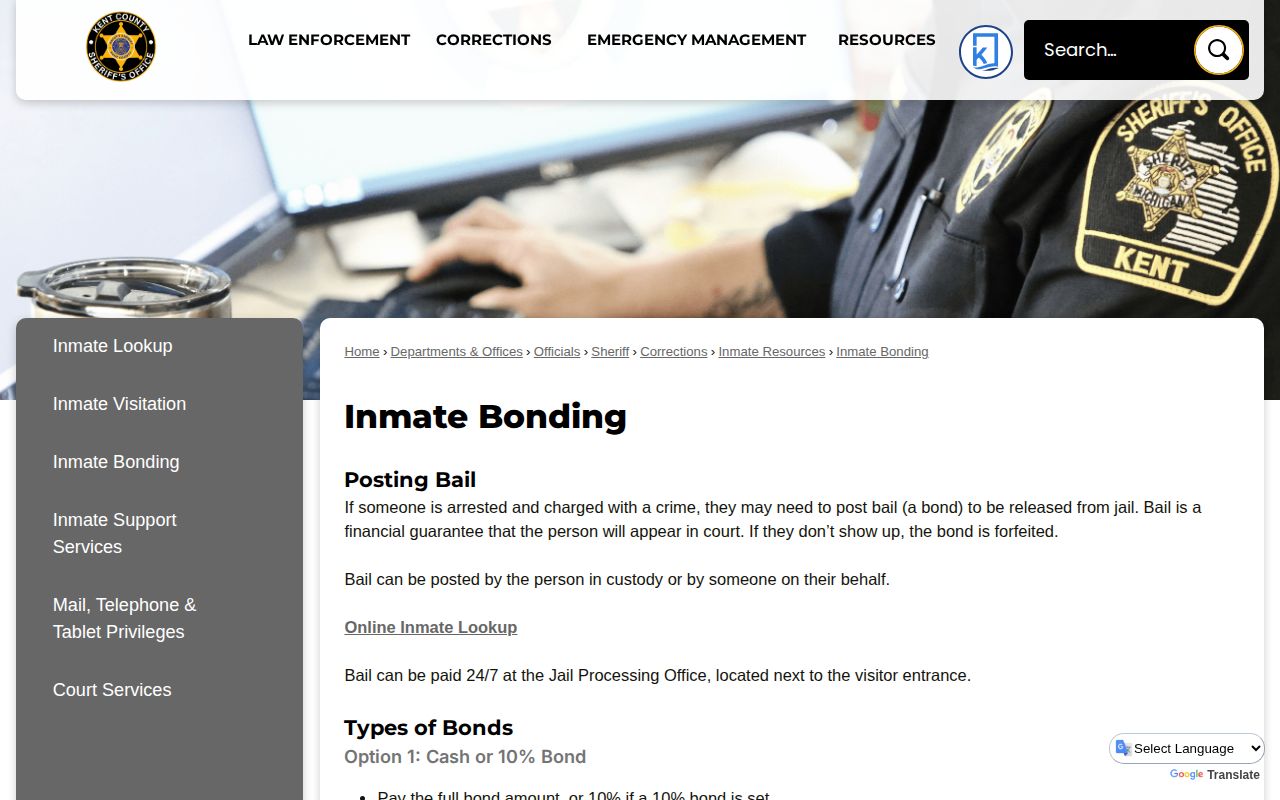
The payment channels help explain a bond departure, but only the custody record confirms that processing produced a physical release.
Kent County Release Status Paths
Use the custodian that owns the event. KCSO can confirm whether and how a person left KCCF. The criminal court explains the order. OTIS answers later state-prison, parole, probation, and discharge questions. BOP and ICE cover their own federal systems. No one tool is a universal Kent County release database.
| Status question | Best source | Limit |
|---|---|---|
| Still held at KCCF? | Jail Viewer and inmate phone line | A no-hit does not identify what happened next. |
| Left KCCF in the last 24 hours? | KCSO release or movement record | Departure may be a transfer, not community release. |
| Bond or court-authorized release? | District or 17th Circuit case | The order may not show physical departure time. |
| Transferred to state prison? | KCCF movement record and OTIS | Leaving county custody is not release from MDOC. |
| Paroled or discharged by MDOC? | OTIS and assigned field office | Parole remains supervised; discharge ends the term. |
If public sources disagree, keep the dates separate. The legal order date, KCCF departure, receiving-agency intake, parole start, and final discharge can all be valid yet different. Do not average them or choose the most recent screen without asking the source agency what its field means.
A federal or immigration event needs another route. A BOP result can show a historical federal release date, while ICE’s locator covers qualifying immigration custody within its limits. Neither system proves how a local KCCF booking ended. When the county movement record says “other agency,” ask KCSO to identify the recipient before moving to the appropriate federal source.
Note: A live roster documents current KCCF custody, while a release record documents the earlier event that ended that specific booking.
Kent County Release App Limits
Kent County has official Sheriff apps for iOS and Android. Their official descriptions advertise agency resources, reporting concerns, crime prevention, and online reporting. They do not advertise inmate lookup, recent-release lists, or booking photos. As of the research date, the apps should not be treated as a Kent County 24-hour release channel.
The confirmed digital channels are the website Viewer and MI-VINE. KCSO Records is the documented route for older inmate records, and its service-fee page lists $5 per inmate photo if available for release. This negative app finding is dated, not permanent. A future update should be checked through the official publisher and tested for the exact window before its output is labeled an official list.
Note: An official app publisher does not establish that the app includes a release list, roster, or booking-photo feature.
Request Kent County Release Proof
The Kent County FOIA process accepts requests online, by mail, fax, or hand delivery. Identify KCSO, the full name, approximate booking date, booking number, and the exact 24-hour start and end. Ask for the release or disposition screen and jail movement record showing date, time, type, and destination. Electronic delivery and an itemized estimate can keep the request clear.
Kent states that it responds within five business days or may issue a ten-business-day extension. A response may grant, deny, partially grant, seek clarification, provide a fee estimate, or extend the time. KCSO Records is at 701 Ball Avenue NE, Grand Rapids, with phone 616-632-6200 and fax 616-632-6217. Its general hours are weekdays from 9 a.m. to 5 p.m., with Wednesday noon to 12:30 p.m. listed as appointment only.
Ask for exempt passages to be redacted rather than having separable public material withheld. Court records must be requested from the proper clerk, and MDOC records use the state department’s own FOIA process. For a named person rather than a time-window review, the Kent County released-inmate search path reconciles those custodians.