
Kent County Projected Versus Actual Release
“Projected release date” is a broad search phrase, not one universal Michigan field. For an MDOC prisoner, OTIS uses Earliest Release Date, or ERD. MDOC says it should not be treated as a definite release date. ERD generally marks when parole may first become possible under the sentence and applicable credit rules. A current prisoner status remains controlling even if an ERD has passed.
For a probationer, the comparable OTIS column can refer to supervision release. Date Paroled is retrospective: it records when the person left prison or camp, or when parole status began under nonsecure supervision. DISCHRG means MDOC supervision for that sentence ended. Maximum Discharge Date is the calculated outer point beyond which MDOC generally cannot hold the person without other legal authority.
Scheduled versus actual: An ERD or KCCF end-of-sentence field is a computation. A departure record or Date Paroled establishes the later physical event.
A pretrial KCCF detainee has no sentence-based release date. Bond, dismissal, trial, plea, a new order, or another hold can determine what happens next. Calling an upcoming hearing a projected release would overstate the record.
Find Kent County Projected Release Dates
Begin with the legal custodian. A person sentenced in Kent County may stay at KCCF for a county term or transfer to an MDOC prison elsewhere in Michigan. No active state prison is listed in Kent County, so location alone cannot tell which sentence system applies. The county inmate page is the official starting point for KCCF custody.
- Confirm identity with full name, birth information, booking or case number, and MDOC number when known. Do not match on name alone.
- For KCCF, use the Kent Jail Viewer and call inmate information at 616-632-6300. Ask what an end-of-sentence field means for that booking.
- Use the Kent County court directory to reach the right clerk, then read the judgment for the term, jail credit, consecutive terms, probation, or commitment to MDOC.
- For a state prisoner, search MDOC OTIS by MDOC number or name. Confirm county, offense, aliases, and sentence before reading ERD.
- Compare ERD with current status, maximum discharge, and any Date Paroled or discharge field. Never convert ERD into a promised release.
- When fields conflict or an older record is outside public display, contact the custodian or request the specific KCSO or MDOC computation record.
The Kent County released-inmate search provides the broader path when the person has already left custody. For a future event, keep court authority, calculated eligibility, and actual departure as separate dates.
Note: OTIS is not a county booking database, so a person who only posted bond or served a local jail term may have no result.
Michigan Release Date Computation
Michigan uses different rules for county jail and state prison terms. For an indeterminate MDOC sentence, the judge sets the minimum and statute supplies the maximum. MCL 791.234 generally places an eligible prisoner under Parole Board jurisdiction after the minimum, with legacy credits where applicable. Consecutive terms, life sentences, offense-specific limits, and the offense date can change that analysis.
Michigan is not a universal “85 percent” state. MDOC describes truth-in-sentencing for specified assaultive offenses committed on or after December 15, 1998, and other covered offenses committed on or after December 15, 2000. Those prisoners generally must serve 100 percent of the judicial minimum in secure custody before parole eligibility, subject to specialized exceptions. Good-time or disciplinary credits do not reduce that minimum in the way an older regime could.
MCL 800.33 governs legacy good-time and disciplinary-credit rules, including forfeiture and restoration. Offense date matters. Applying an old credit table to a modern truth-in-sentencing offense can create a false date. MCL 791.233 also places conditions on a Parole Board release; reaching eligibility does not compel a grant.
Consecutive terms also resist a one-line estimate. They can require one term to follow another before a controlling eligibility or maximum date is reached. Life and offense-specific provisions introduce still more limits. The safest public reading is descriptive: record the sentence dates OTIS shows, state that ERD is eligibility rather than a promise, and obtain the official calculation when the reason for the date matters.
- Minimum term
- The judicial portion that ordinarily controls when parole consideration can begin.
- Maximum term
- The statutory outer sentence term, subject to lawful computation and other authority.
- ERD
- The earliest release or parole-eligibility date shown by OTIS, not a guarantee.
- Parole
- Conditional release from prison while MDOC supervision continues.
- Discharge
- The end of MDOC supervision for the sentence shown.
Kent County Jail Good-Time Quirk
A county jail sentence uses a different rule. MCL 51.282 permits a sheriff to reduce a jail term for good behavior within the statute’s conditions. It does not promise that each KCCF inmate receives the largest possible reduction. The judgment, jail credit, behavior, other cases, and holds can still affect the calculation.
The Kent Jail Viewer can display an “End of Sentence Date,” but that field is not proof of departure. During the July 24, 2026 research check, a live public example showed an end date earlier than its “IN CUSTODY as of” banner. That conflict is the distinctive local warning: the current banner cannot be overwritten with a date-derived guess. Call KCCF and check the court for another charge, detainer, corrected computation, or timing issue.
The official county-jail good-time statute is the source behind that part of a Kent County sentence calculation.
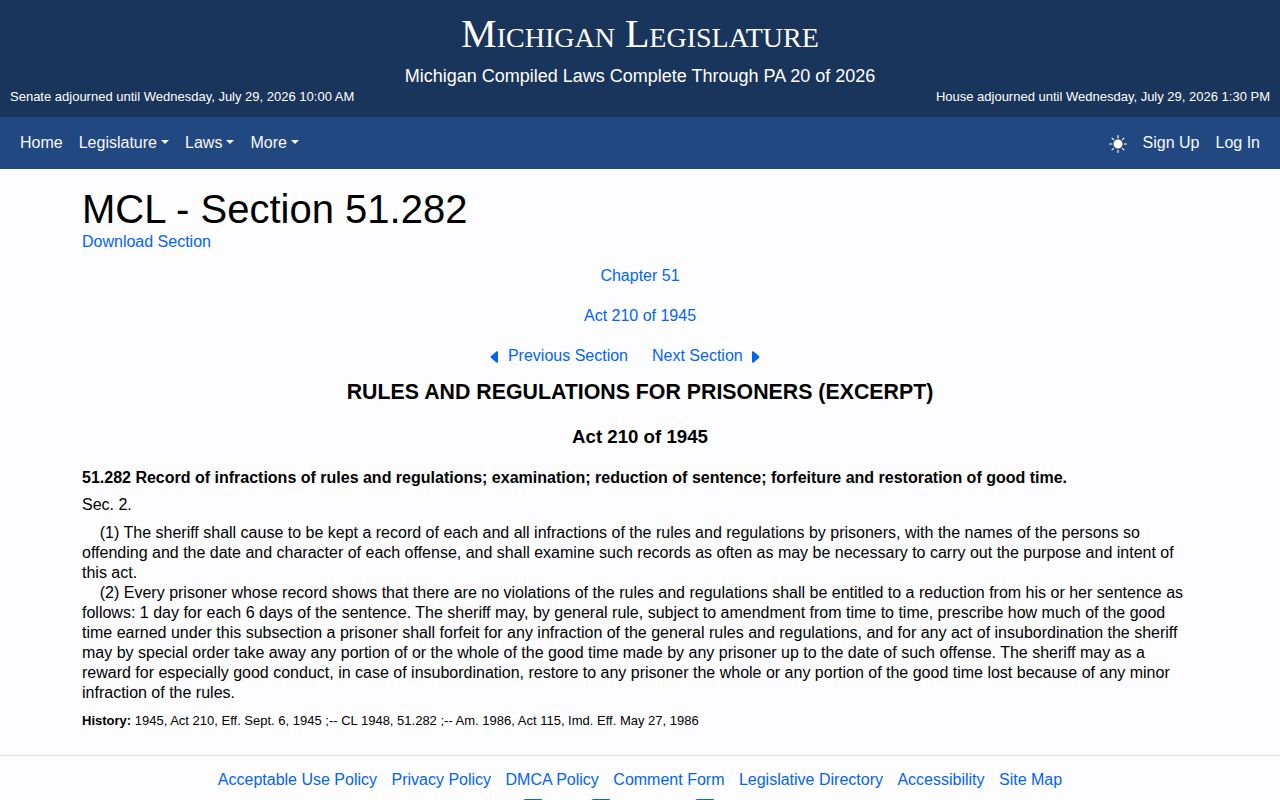
The statute supplies authority for a possible reduction. KCCF’s actual record and the court judgment establish how the rule was applied to one sentence.
Note: An End of Sentence Date may be useful for inquiry, but the KCCF status banner and direct agency confirmation control the current custody question.
Kent County Release Date Changes
A projected date can move without any single source being dishonest. Sentence calculations respond to legal orders, earned or lost legacy credit, and other custody. Parole eligibility can remain unchanged while the Board denies, defers, or continues consideration. Even a grant can be suspended before physical release if misconduct or new adverse information appears.
| Factor | Possible effect | Where to verify |
|---|---|---|
| Corrected judgment or jail credit | Changes the sentence base or credited time. | Sentencing court and computation record |
| Consecutive sentence | Moves eligibility or maximum dates by linking terms. | Judgment and MDOC sentence detail |
| Legacy credit or misconduct | Adds, forfeits, or restores credit where the regime permits. | MDOC time-computation record |
| Parole denial or continuance | Leaves the person in prison after ERD. | OTIS status and Parole Board action |
| Detainer or another hold | Prevents community departure or sends the person to another custodian. | Holding agency, jail, and court |
| Appeal, new case, or new sentence | Creates new authority or changes the controlling term. | Court records and custodian |
A detainer is a request or legal notice that another authority wants custody or action. It can explain why a sentence field has arrived while release has not. Ask KCCF or MDOC to identify the holding authority rather than assuming the person will leave for the community.
Parole status adds a second timeline. The Michigan Parole Board may grant, deny, defer, or continue consideration under the applicable rules. A grant is not the same as Date Paroled, since new adverse information or misconduct can suspend it before departure. After departure, the person remains under MDOC legal supervision until discharge, and a violation may lead to revocation.
Kent County Custody Alternatives
Physical movement does not always end a sentence. MCL 801.251 addresses sheriff-authorized jail alternatives and work-release provisions. Kent County also operates correctional and reentry programs. A move into or out of a community placement can change where a person sleeps without creating final discharge from the court’s sentence.
The court order and supervising source must define the status. Kent County Court Services can supervise some defendants released on bond or under local conditions. MDOC Field Operations administers state parole and probation. Neither should be inferred from a roster disappearance, and local pretrial supervision should not be labeled parole.
The Michigan jail-alternative statute provides legal context for custody outside a standard jail cell.
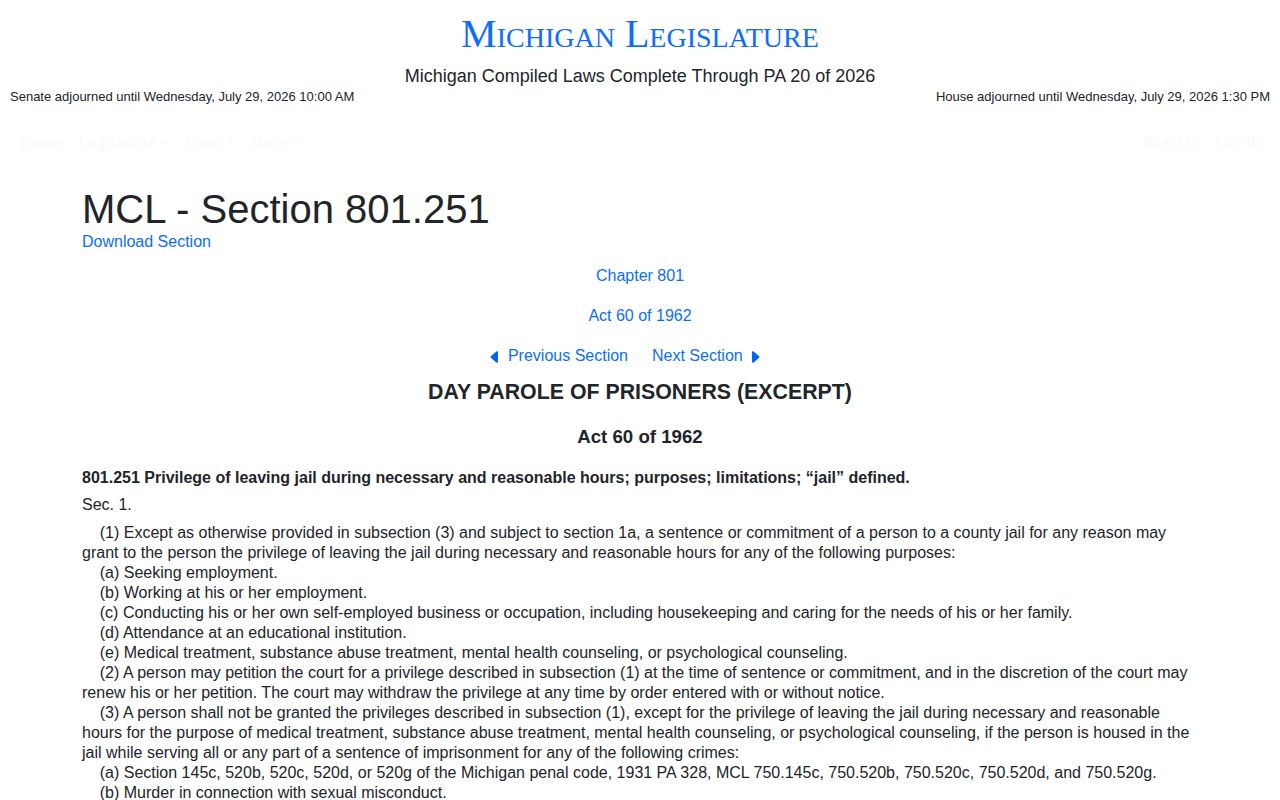
The source supports the existence of authorized alternatives, but the person’s own order is needed to tell whether a move changed custody, supervision, or the projected end date.
Kent County’s Community Re-entry Center is one reason that physical location and legal status must be kept apart. Movement into or out of the program is not necessarily final discharge. A participant outside secure custody may still be subject to probation or another community sanction. The jail record, supervising source, and court order must be reconciled before describing the projected end.
Kent County OTIS Date Limits
OTIS is built for MDOC jurisdiction, not every Kent County arrest. It can show an MDOC number, status, supervising office, sentence offenses, county and court, minimum and maximum dates, ERD, Date Paroled, and discharge information when those fields apply. A person who posted bond or served only a local jail term may never enter that database.
Public retention also affects a no-result. MDOC states that discharged records remain in OTIS for three years after supervision discharge. An older person may therefore stop appearing even though the court judgment still exists. That absence should not be translated into “never in MDOC.” Use MDOC FOIA or the sentencing court when the record is outside OTIS publication rules.
Identity must be checked from more than the date. Confirm the MDOC number when possible, then compare aliases, age or birth data, county, offense, and sentence. An image is only a state correctional photo and does not establish current prison status. The current status label should be quoted exactly, especially when it says parole, probation, prisoner, absconder, or discharged.
Note: A Kent address or supervising office does not prove that the person served time in a prison located in Kent County.
Confirm Kent County Release Timing
For KCCF, compare the Viewer with the judgment and call inmate information. Request the release screen or jail movement record if the exact time and destination matter. For MDOC, read OTIS first, then contact the listed field office or use MDOC FOIA for a disputed time computation. A public status snapshot may not contain every credit, continuance, or detainer.
MI-VINE can add an event alert. A KCCF registration can report release, transfer, or escape when the agency submits the event, while a state-prison registration provides general release notification. Delivery or source-data delay can occur, and the reported status does not rule out another hold. The Kent County VINELink check details how to match the person and read the event.
Keep four dates distinct: the court order, calculated eligibility, physical departure, and final discharge. Date Paroled is stronger proof of a past prison departure than ERD. A KCSO movement record is stronger proof of a past county-jail departure than an End of Sentence Date. When tools disagree, contact each custodian about its own event and report the unresolved difference instead of building a new date from percentages.
A county release-record request should name the booking and ask for the release or disposition screen, jail movement record, end-of-sentence field, and destination if transferred. An MDOC request should name the six-digit MDOC number, sentence, county, date range, and the specific parole, discharge, or time-computation record. Court clerks supply judgments, amended sentences, and probation-discharge orders rather than county administrative FOIA.
Note: Last checked July 24, 2026; live OTIS, Viewer, statute, and contact details should be rechecked before relying on a future event.