
MI-VINE Coverage in Kent County
MI-VINE stands for Michigan Victim Information and Notification Everyday. The service is free, confidential, and available at all hours through VINELink or the automated phone line. Kent County’s official inmate page links to it, which establishes MI-VINE as a local custody-notification channel. County-jail registrations can cover reported release, transfer, and escape events. State-prison enrollment can provide a general release notification for an MDOC record.
Coverage follows the reporting custodian. A Kent County Correctional Facility event and an MDOC prison event are not the same record. Someone who leaves KCCF for an MDOC prison has departed county custody but has not been released to the community. VINELink may report the county transfer, while Michigan OTIS becomes the main public source for the state sentence, prison status, parole, or discharge.
MI-VINE is not the principal federal locator. A federal prison record belongs in the BOP Inmate Locator, and immigration custody belongs in ICE’s system. It is also not a general list of everyone released in Kent County. Search one person, match the correct agency, and interpret only the event that agency reports.
The official Michigan MI-VINE overview confirms the state service and its role. The captured page below shows the official local layer behind a Kent County VINELink check.
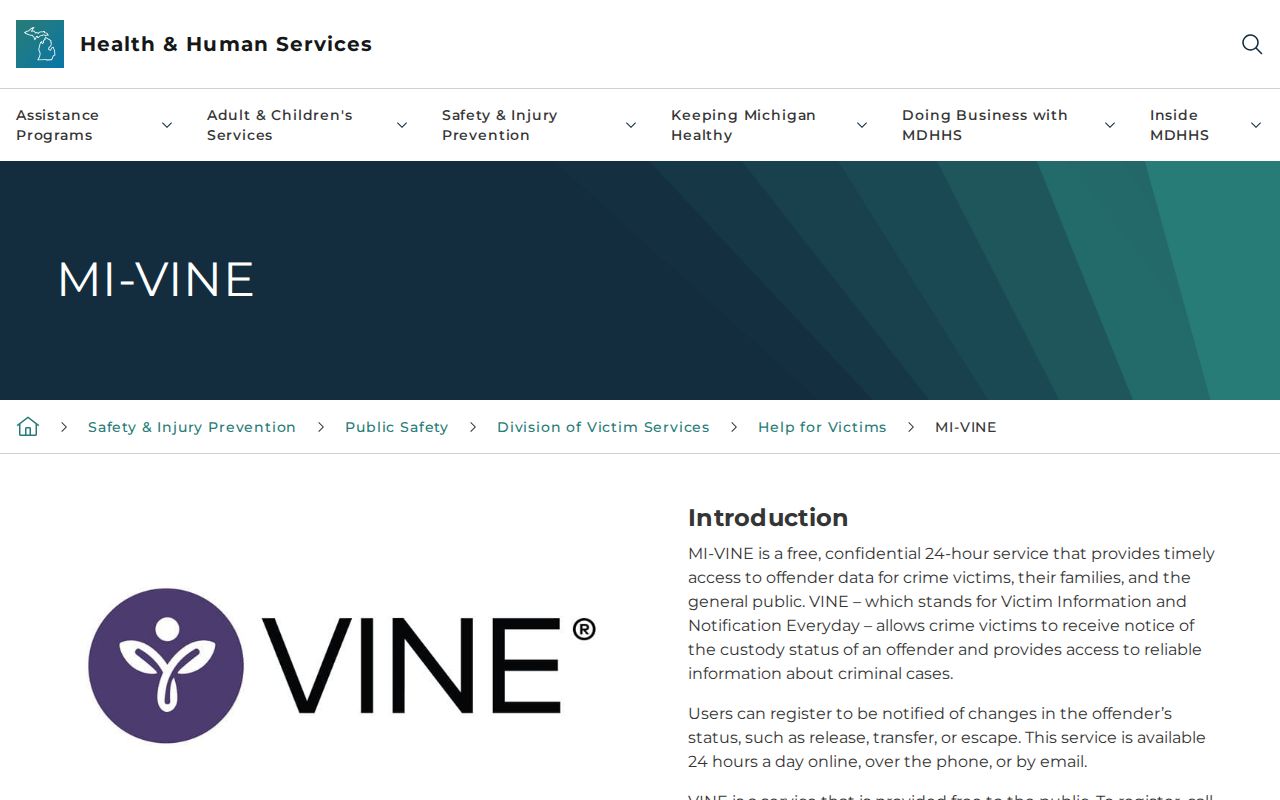
Use the official overview to reach the current service, then keep the reporting facility and event type with any saved status note.
Search a Kent County Inmate
Identity matching comes first. A name alone can point to the wrong person, especially when several records share a surname. Use an offender, booking, or MDOC identifier when the interface offers one. Otherwise compare the full name, age or birth details, facility, and reporting agency. Never assume that the first result is the intended record.
- Open VINELink or call 800-770-7657, then choose Michigan.
- Select the offender or custody search. Enter the complete name or the identifying number offered by the current screen.
- Compare all returned matches. Confirm the facility or agency and any available identity details before opening a record.
- Read the exact custody label and event date. Keep “released,” “transferred,” and “out of custody” separate.
- If an alert is needed, register from the correct person’s record. Do not register from a similar-name result.
A no-result is not proof of release. Spelling, agency participation, data timing, transfer, and record-display rules can all cause a miss. Search the Kent Jail Viewer for a KCCF booking, OTIS for an MDOC record, or the correct federal system when the person’s custody path points elsewhere.
The Kent Jail Viewer and VINELink answer related questions from different interfaces. The Viewer is the county’s current booking and custody starting point. VINELink adds reported event status and notification enrollment. If the Viewer still marks the person in custody while VINELink reports release, save both dates and call KCCF. A late feed, a similar-name match, or a later return to custody may explain the conflict. Do not discard either result until the agency identifies the correct booking and event.
The broader Kent County released inmate lookup explains how to reconcile the jail record, court case, state record, and records-request fallback when one system cannot settle the question.
Note: Search labels and buttons can change, so these steps describe the official workflow as checked on July 24, 2026.
Kent County VINELink Release Fields
A VINELink result is a status report from a participating agency. It may identify the person, reporting facility, custody state, and the date of a reported event. Availability varies by record. The most useful practice is to transcribe the label that appears rather than replace it with a broader conclusion.
| Field or label | What it can show | What it does not prove |
|---|---|---|
| Name and identifier | The person associated with the reporting record | Identity without comparison to other details |
| Reporting agency or facility | Which custodian supplied the status | Status in every other jail or agency |
| Custody status | The agency’s current reported label | A universal clearance from all custody |
| Release or event date | When that custodian reported a covered event | The date a court ended the case or supervision |
| Transfer event | Departure from one reporting facility | Release into the community |
| Notification options | Available alert methods for that record | Guaranteed instant delivery |
A court can still show an open case after VINELink reports release on bond. That is normal. The release event concerns physical custody, while the court record concerns the case and its conditions. Likewise, an OTIS parole status means the person is outside secure prison custody under MDOC supervision, not discharged from the sentence.
Register Kent County Release Alerts
Registration attaches a chosen contact method to a specific custody record. It should be done before the expected event when possible. Phone, email, and text options may appear, depending on the current interface and record. Keep all contact data and the phone PIN private.
- Open the matched record and choose “Register for Notification,” or the equivalent current button.
- Select phone, email, or text where offered. Enter the destination carefully and review the event types shown.
- For phone registration, create a four-digit PIN. Store it where only the registrant can reach it.
- When the automated call arrives, listen to the message and enter the PIN followed by the number sign. That acknowledgment stops repeat calls for the event.
- Complete any email or text confirmation shown by the service. Those methods do not use the phone PIN and generally send one message for a changed event.
The official Michigan brochure says automated calls may repeat until the PIN is entered or for up to 24 hours. An operator can help with registration or PIN reset. A missed alert, blocked email, changed phone number, or agency reporting delay does not alter the underlying custody record.
Registration should be checked after a phone number or email address changes. Use the matched record, not a saved search for a broad name, and review which events are offered. A transfer notice may arrive before a later release notice because the first custodian has completed its own event. The receiving agency then controls the next status. This sequence is common when county custody ends through transfer rather than community release.
MI-VINE should supplement direct verification. If an event has immediate importance, call the responsible jail or agency. For KCCF, the inmate-information line is 616-632-6300, option 1. Request the KCSO release or movement record when the exact date, time, type, or destination must be documented.
Kent County Victim Notice Layers
General MI-VINE custody alerts and MDOC’s direct-victim notification program serve related but distinct roles. County-jail enrollment can provide release, transfer, or escape alerts from a participating record. A general state-prison VINELink registration can provide notice of a release event. Neither should be presented as the full set of notices available to a direct victim in an MDOC case.
Direct victims who seek added parole hearing or decision notices must register separately with MDOC’s Crime Victim Notification Unit. The official MI-VINE and MDOC notification brochure explains that added layer. The unit’s phone number is 877-886-5401.
This separation matters in Kent County because a person can move from KCCF into MDOC custody. A county registration may report the jail transfer, while later parole-process notices come from the state victim-notification channel. Keep both registrations current when both systems apply. Do not assume enrollment in one automatically enrolls the other.
Note: MI-VINE enrollment does not automatically register a direct victim for the fuller MDOC parole-notice program.
Confirm Kent County VINELink Results
VINELink is timely but not a certified universal custody clearance. A “released” or “out of custody” result means the reporting custodian recorded a departure. It does not rule out another hold, warrant, transfer, parole, probation, or a separate agency’s custody. A no-hit has the same limit in reverse. It cannot establish that the person was released.
Use KCSO’s release or movement record for a Kent County jail episode. That record can identify the release time, type, and receiving agency when those fields are maintained. Use OTIS and the assigned MDOC field office for state prison, parole, probation, or discharge. The court case explains bond, dismissal, sentence, and probation orders, but may not show the exact jail-door departure time.
For federal prison, use the BOP locator. For qualifying immigration custody, use ICE’s Online Detainee Locator. MI-VINE does not replace either system. The Michigan State Police sex offender registry is also separate. It covers people subject to that specialized law and is not a general Kent County release archive.
A KCSO movement record is the strongest county document when the question is whether someone left the Kent County Correctional Facility and where that person went. The court order may authorize bond or commitment, yet the physical move can occur later. OTIS may then show state reception, parole, or discharge on still other dates. VINELink fits between those records as an event and alert service. Its value increases when the status is kept with the reporting agency and time, rather than copied as a stand-alone claim.
- Release
- A reported departure from the named custodian, which may be to the community or another agency.
- Transfer
- Movement from one custodial agency or facility to another.
- Parole
- Release from state prison into supervised community status.
- Discharge
- The end of the correctional supervision term shown by the responsible agency.
When public tools conflict, preserve each event and date. Separate the court order, physical departure, receiving-agency intake, parole start, and final discharge. Contact each custodian about its own record instead of selecting the most convenient status.
Save only what is needed to resolve the status. A clear note can identify the person, reporting agency, displayed label, event date, and time checked. If the status later changes, keep the two snapshots as separate observations. That record makes it easier for KCSO, MDOC, or a court clerk to identify a delay or mismatch without overstating what the earlier VINELink screen proved.