
Kent Has No MDOC Prison
The current MDOC prison directory shows no active state prison physically located in Kent County. No local detention site should be invented for this statewide system. A person sentenced in the 17th Circuit Court usually leaves Kent County Correctional Facility for MDOC reception and can be assigned to a prison elsewhere in Michigan. That county-to-state move is not release to the community.
Prison location and home or supervision county can differ. Bellamy Creek Correctional Facility is in neighboring Ionia County, and its official page identifies Kent among the counties served through parole in-reach work. A person may therefore serve time outside Kent and later parole to a Kent address. The statewide status record, not county geography, is the reliable route.
Search Kent Cases in OTIS
Michigan’s Offender Tracking Information System, known as OTIS, is the principal public source for people within its state correctional scope. Search by the six-digit MDOC number when known because it identifies one correctional record. Otherwise, use the person’s last and first name and the filters offered. Open the result and compare aliases, age or birth information, offense, sentencing county, and court before accepting the match.
- Open Michigan OTIS and search by MDOC number or name.
- Confirm identity with the Kent County sentence, offense, aliases, and available personal descriptors.
- Read the current status and location or supervising office exactly as shown.
- Record Date Paroled, discharge wording, and sentence dates separately.
- Contact MDOC or request the relevant record when the public profile is missing or conflicts with another source.
OTIS is not a Kent County booking database. A person who posted bond or served only a county-jail sentence may never appear. In that case, KCSO and the court remain the correct custodians. The Kent County release search covers that local path.
Note: OTIS status controls over a homemade date calculation when the profile still identifies the person as a prisoner.
MDOC Release Record Fields
A matched OTIS profile can publish several kinds of state correctional data. Transcribe labels as displayed instead of turning each date into a promised release. The field inventory is most useful when identity, sentence, location, and status are read together.
| OTIS field | How to read it |
|---|---|
| MDOC number and identity | Connects the profile to one state correctional record. |
| Current status | May distinguish prisoner, parole, probation, absconder, or discharged status. |
| Location or supervising office | Shows the published prison or community office tied to the status. |
| Earliest Release Date | Represents eligibility under the applicable framework, not guaranteed departure. |
| Date Paroled | Retrospective evidence of departure from prison into parole status. |
| Maximum discharge date | A calculated outer sentence date subject to lawful changes and other authority. |
| DISCHRG | Means MDOC supervision for the sentence shown has ended. |
A state correctional image, when present, is not necessarily the booking photo from KCCF. The sentencing county and case should be checked before connecting an MDOC profile with a local booking. OTIS officially keeps discharged records for a limited period, including three years after supervision discharge, so an older no-result does not mean the person was never in MDOC custody.
Kent Parole Versus Discharge
Parole means the person has left secure state prison while remaining in MDOC legal custody and supervision. The public record may show Date Paroled and a Kent field office. That is a community release, but it is not the end of the sentence. “DISCHRG” is the more final state term because MDOC defines it as the end of supervision for the sentence displayed.
Probation is different. It is a court sentence served in the community and does not mean a person was released from an MDOC prison. An absconder or warrant notation also is not a successful discharge. When OTIS assigns a Kent office, Field Operations Administration is the confirmation route for active state supervision. County Court Services is separate and handles some local pretrial and community cases.
- Prisoner
- A person shown in secure MDOC custody.
- Parole
- Community release from prison with MDOC supervision still active.
- Probation
- A court-imposed community sentence, not a prison-release status.
- Discharge
- The documented end of MDOC supervision for the listed sentence.
MDOC Release Date Limits
Michigan’s official term is Earliest Release Date, or ERD. MDOC warns that it should not be treated as a definite release date. For an eligible prisoner, it can mark parole eligibility under the sentence and credit framework. The Parole Board may deny, defer, or continue consideration, and detainers, misconduct, corrected judgments, consecutive sentences, appeals, or new sentences can affect the path.
Michigan is not governed by a universal 85-percent rule. For covered truth-in-sentencing offenses and dates, the judicial minimum generally must be served in secure custody before parole eligibility. Older or specialized credit regimes depend on the offense date and statutes such as MCL 791.234 and MCL 800.33 through 800.35. Do not import a federal shortcut or subtract a percentage from the sentence. The judgment, current OTIS status, and MDOC calculation govern.
Note: A passed Earliest Release Date opens a possible parole stage; it does not override a current prisoner status.
MDOC Release Record Contacts
Because there is no active MDOC prison in Kent County, use the statewide agency route and the office named by the record. The public MDOC contact directory routes prison, Field Operations, and other agency questions. Its FOIA process is the fallback for a public discharge, parole, or time-computation record that OTIS does not provide.
Michigan Department of CorrectionsStatewide prison and records system
MDOC contact directory
No active MDOC detention site identified in Kent County Michigan Parole Board
Phone: 517-373-0270
Email: Parole-Board-Staff@michigan.gov
Monday through Friday, 8 a.m. to 5 p.m.
Name the six-digit MDOC number, person, date range, Kent County sentence, and exact record sought. Do not request a restricted PENPACK as a public shortcut. MDOC describes that procedure for recognized criminal-justice authorities acting in official business.
MDOC Statewide Prison Directory
The official MDOC prison directory shows the statewide institutions that replace geography-based guesses for a Kent County prison sentence.
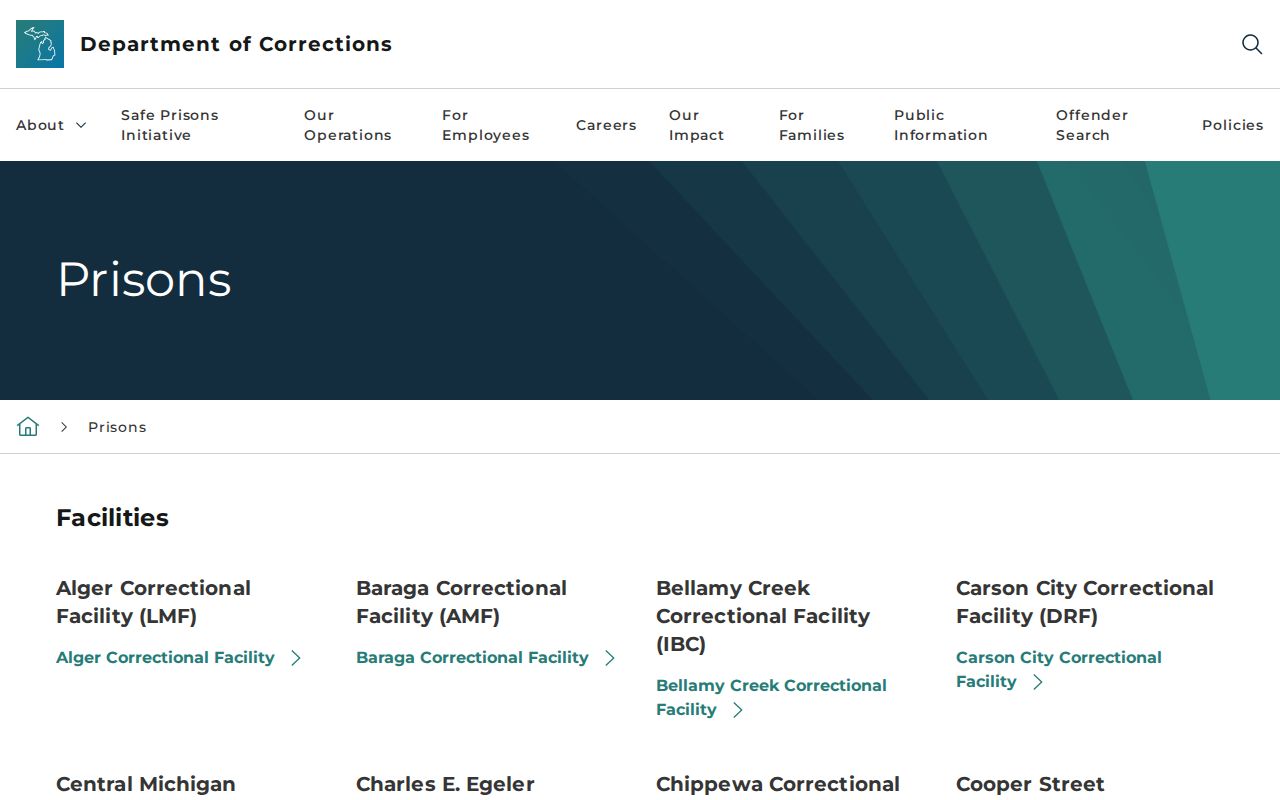
The directory confirms that a Kent sentence can lead to a prison elsewhere in Michigan and that no current prison listing appears within Kent County itself.
Kent Sentences and MDOC Transfers
The court and MDOC document different steps. A Kent County judgment of sentence establishes commitment to MDOC. The KCSO movement record can establish when KCCF transferred the person. MDOC reception and prison assignment occur later. A future Date Paroled records another event, and final discharge can occur later still. Those dates should not be collapsed.
If a person disappears from the Kent Jail Viewer after a prison judgment, search OTIS and ask KCSO for the receiving destination. If OTIS shows a current prison, report a transfer to state custody. If OTIS later shows parole, report that later community event separately. The 17th Circuit case can also reveal an amended judgment or sentence correction that explains a date change.
Bellamy Creek’s in-reach role illustrates the difference. Its official page identifies Kent among the counties served for people preparing to parole, but Bellamy Creek is in Ionia County. The facility of confinement, the county of conviction, and the community supervision office can therefore be three different places. A Kent parole office assignment does not prove the person was held in Kent, and an Ionia prison location does not change the Kent sentencing record.
When the judgment and OTIS appear out of sequence, keep reception, eligibility, parole, and discharge dates separate. An amended court order may change the sentence calculation, while the public OTIS record may update on another schedule. Ask the court about its judgment and MDOC about its status. Neither office should be asked to certify the other custodian’s event.
Request an MDOC Discharge Record
Use the MDOC records request route for an older or disputed state event. Define the document: a discharge record, parole record, or time-computation record for the named person and MDOC number. Include the relevant date range, sentence, and Kent County court. A precise request helps MDOC locate the record without asking the agency to draw a legal conclusion.
For older public information that has aged out of OTIS, pair the MDOC response with the judgment and any later court corrections. A no-hit can result from public display limits, identity mismatch, or a record outside OTIS coverage. It cannot prove the absence of a prior state sentence. Keep federal and immigration systems separate too. OTIS does not answer BOP or ICE custody questions, and neither federal locator proves a Michigan discharge.
Final verification rests on exact status language. “Prisoner,” “parole,” “probation,” and “DISCHRG” carry different meanings. Preserve the status date, location, sentencing county, and source check date. If the public screen and a document disagree, contact MDOC about the state record rather than treating the newest-looking screen as automatically correct.
Note: Record the date OTIS was checked because prison location, supervision office, and status can change after a prior search.