
Kent County Parole and Probation
A person can live in Kent County and still have an active correctional status. Parole means conditional release from an MDOC prison sentence. The person has left secure prison custody, but MDOC still supervises the sentence. Probation is imposed by a court, often instead of prison or after a county jail term. It places the person in the community under stated rules. A person released on bond may instead report to Kent County Court Services while the criminal case remains open.
Those paths create different records and contacts. The Michigan Offender Tracking Information System, known as OTIS, is the first public check for MDOC parole or probation. It is not a complete list of people who posted bond or served only a local jail sentence. Court Services handles some local pretrial conditions, and the court register shows the order that created them.
| Status | How it begins | Best verification source | What completion means |
|---|---|---|---|
| Parole | Release from an MDOC prison sentence | OTIS and the assigned MDOC parole office | Discharge ends MDOC supervision for that sentence |
| Probation | A court orders community supervision | OTIS when MDOC supervises, plus the sentencing court | A discharge order or completed status ends that term |
| Pretrial supervision | A court releases a defendant while the case is pending | Kent Court Services and the court case | The court modifies or ends the pretrial order |
- Parole
- Conditional community release from a state prison sentence while MDOC retains supervision.
- Probation
- A community sentence imposed by a court, with rules enforced by a supervising agency.
- Discharge
- The formal end of the listed correctional supervision term.
- Absconder
- An agency status alleging that a supervised person cannot be located or has stopped reporting.
Verify Kent County Post-Release Supervision
Start with a precise identity. A shared name can lead to the wrong MDOC record, so compare the MDOC number, age or birth details, aliases, offense, sentencing county, and the listed supervising location. Then read the status word exactly. “Parole” is not the same as “discharged,” and a prison location is not community release. An absence from OTIS also proves very little because jail-only cases may never appear and discharged records have a limited public display period.
- Open OTIS and search by the six-digit MDOC number when known. Otherwise, use the complete name and available filters.
- Open the matching detail and compare more than the name. Confirm Kent County, the sentence, identifying details, and any aliases.
- Read the current status, date paroled or discharge data, and supervising office exactly as displayed. Do not turn an eligibility date into an actual release date.
- Use the office tied to that status. Call Kent parole for a parole record and Kent probation for an MDOC probation record.
- Check the court register when the person left KCCF on bond, received local probation, or has a disputed warrant or discharge entry.
- Request an MDOC record or court order if the public tools conflict. Each custodian should confirm only the event it created.
The full county-jail release path and its records-request fallback are set out in the Kent County released inmate search. Use that route when OTIS has no match and the known event was a KCCF booking.
The official MDOC Region 4 office directory shows the Kent offices used to verify state supervision. The directory screen below helps distinguish the two local destinations.
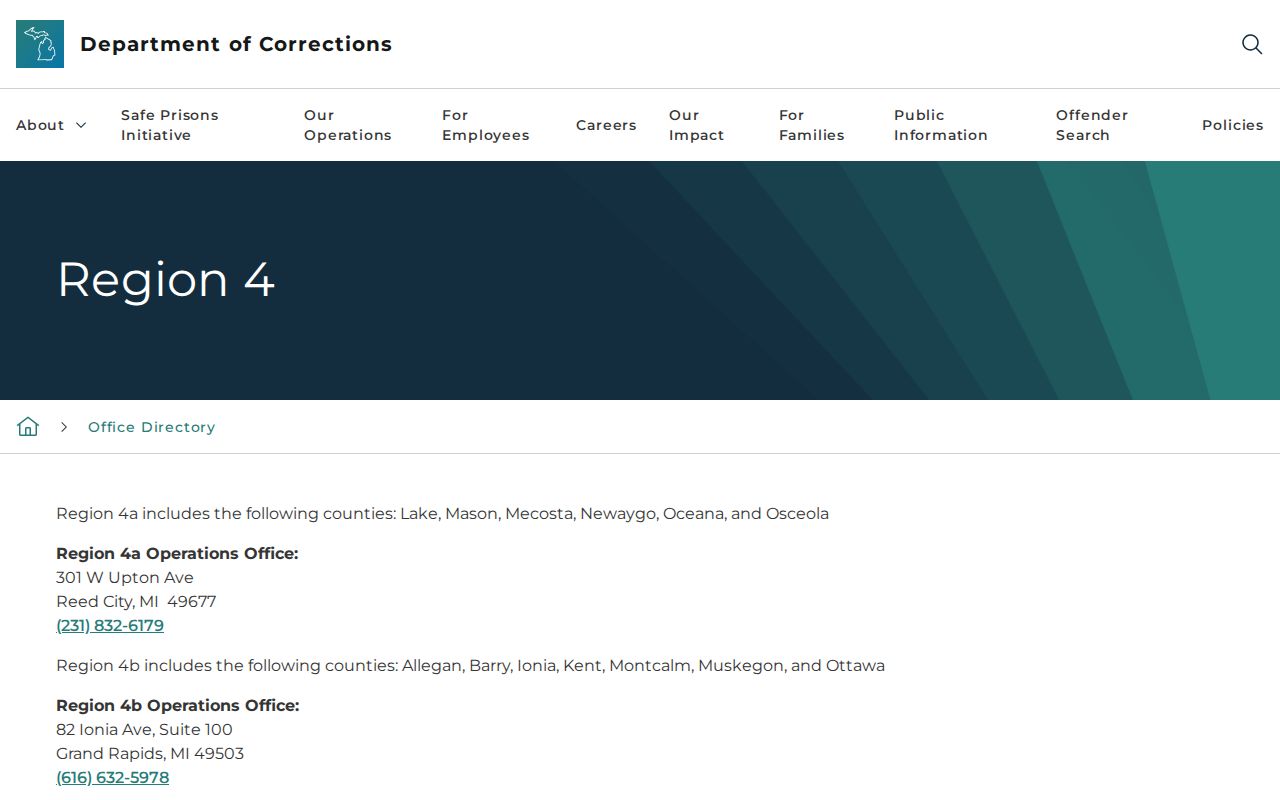
Use the office that matches the OTIS status. A Kent address alone does not prove that a person was imprisoned in Kent County or that MDOC supervision remains active.
Note: Live status and office assignments can change, so these instructions and contacts were last checked July 24, 2026.
Kent County Supervision Office Details
Kent County has separate MDOC parole and probation offices. This local split matters. A caller who uses the probation office for a parole record may be redirected, and neither office should be treated as the source for a county bond release. OTIS should identify the type of state supervision before contact is made.
MDOC Kent County Parole Office
1 Division NW
Grand Rapids, Michigan
616-356-0450
MDOC Kent County Probation Office
82 Ionia Avenue NW, Suite 100
Grand Rapids, Michigan
616-632-5920
MDOC Field Operations Administration operates parole and probation offices in every Michigan county. Its work also includes electronic monitoring, interstate compact matters, and response to alleged violations. The MDOC contact directory is the fallback when an OTIS record points outside Kent or when an office assignment is unclear.
Kent County Court Services is a different agency path. It provides pretrial assessment and supervision and works with community alternatives. Its office is at 180 Ottawa Avenue NW, Suite 2100, Grand Rapids, and its phone number is 616-632-5350. A defendant reporting there after bond has not thereby become an MDOC parolee or probationer.
Kent County Supervision Status Changes
Parole and probation conditions are the rules attached to community supervision. They can include reporting, travel limits, treatment, electronic monitoring, or other case-specific duties. The public record rarely provides a complete instruction sheet. The person’s order, parole documents, and assigned agent control. A status check should therefore report only what the public source states.
An absconder notation means the agency alleges that the person is not reporting or cannot be located. It is not a successful discharge. A warrant may arise through the court or the supervision process, and the two records can update at different times. No general KCSO countywide public warrant list was found as of July 24, 2026. OTIS, the relevant court register, and the listed field office must be reconciled instead.
A reported violation also does not establish a final revocation. MDOC or the court must decide what follows. Depending on the legal process, supervision may continue, conditions may change, or custody may resume. Quote the current official status, give its date, and keep the alleged violation separate from the final agency or court decision.
Note: MI-VINE is designed for custody-event alerts, not a complete account of parole or probation rules, violations, and final discharge.
Kent County Reentry After Release
Kent’s local reentry work can begin before a person leaves KCCF. The Kent County Community Corrections program connects court and jail-based planning with community options. Its handbook identifies Arbor Circle case management, the Valued Community Member approach, and New Beginnings among the programs used in that local bridge.
Program participation and legal supervision are not the same fact. Someone may use a reentry service while on probation, parole, pretrial supervision, or no current supervision at all. Likewise, movement into or out of the Kent County Community Re-entry Center does not by itself prove final discharge from a sentence. Verify the legal status through OTIS, the assigned agent, and the court order.
This distinction keeps records clear. Reentry support describes services and planning. Parole or probation describes legal authority. A program referral should not be used to infer an unlisted condition, violation, or custody status.
Note: Reentry participation can overlap with supervision, but a service record does not establish parole, probation, or discharge status.
Kent County Parole Decision Records
The Michigan Parole Board is the state paroling authority, but its public information does not function as a name-by-name decision search. No public master calendar of routine parole interviews was located as of July 24, 2026. Public clemency and other statutorily public matters may appear through MDOC hearing notices. Those notices should not be described as a calendar for every person being considered for parole.
MDOC publishes aggregate quarterly reports with grant, deny, and defer counts. They do not identify each person. A continuance sets a later point for review, while a grant can still be suspended before physical departure if new adverse information or misconduct arises. After release, a violation can lead to revocation. These are different events.
For one person, an OTIS “Date Paroled” is stronger retrospective evidence of departure than an earlier grant or eligibility date. MCL 791.234 supplies the parole eligibility framework, while sentence type, offense date, consecutive terms, and exclusions affect the result. The Parole Board can answer process questions at 517-373-0270, but it should not be asked to promise release or disclose protected case information.
Kent County Supervision Discharge Records
Discharge is the formal end of the correctional supervision shown for a sentence. In OTIS, “DISCHRG” means MDOC supervision for that sentence has ended. It is different from parole, which leaves the person under state supervision, and from a KCCF release on bond, which may leave both the case and local pretrial rules active.
OTIS retains discharged records for a limited period, officially three years after supervision discharge. A later no-result is therefore expected in some cases. It does not mean the MDOC record never existed. For an older state record, use MDOC FOIA and identify the person, MDOC number, county, sentence, date range, and the specific discharge or parole record sought. For court probation, request the probation-discharge order or register entry from the sentencing clerk.
When dates differ, preserve the sequence. A court sentence date, KCCF departure, MDOC reception, parole start, and final discharge can all be valid but describe separate events. Do not average them or choose one as a universal release date. The source that created each event is the best place to resolve a conflict.
A final check should retain the status date and source name. If OTIS shows discharge but the court still lists unpaid obligations or an open register entry, describe each record on its own terms. Court closure, MDOC discharge, and the end of every separate duty are not automatic synonyms. Where the public record remains unclear, ask the sentencing clerk or MDOC office for the specific order or status record instead of drawing a conclusion from silence.